
For a long time, revenue planning was not a topic that kept many IT-company leaders awake at night. Software vendors, IT service providers, and Managed Service Providers (MSPs) were busy — customers showed up, projects ran, margins held. A structured plan? What for?
Today that picture has fundamentally changed. The European economy is in a deep transformation: innovation cycles are shortening, customer decisions are slowing down, and the demands placed on teams and offerings are growing faster than many organizations can respond.
Why so many IT companies operate without real revenue planning
People who grow for years without a plan rarely ask why it has worked so well. The answer is often simple: the market was just there. Customers bought because alternatives were limited or demand outstripped supply.
But that phase is over for most IT companies. Competition is more intense, customer projects are scrutinized more critically, and decision-makers hesitate longer. For revenue planning in IT companies, that means: anyone without a structured approach today will lose market share tomorrow.
Something is always going on. There will never be a moment when the market stands still and everything feels harmonious. That is exactly why you need a plan — not despite the uncertainty, but because of it.
What is the Total Addressable Market (TAM) and why does it matter?
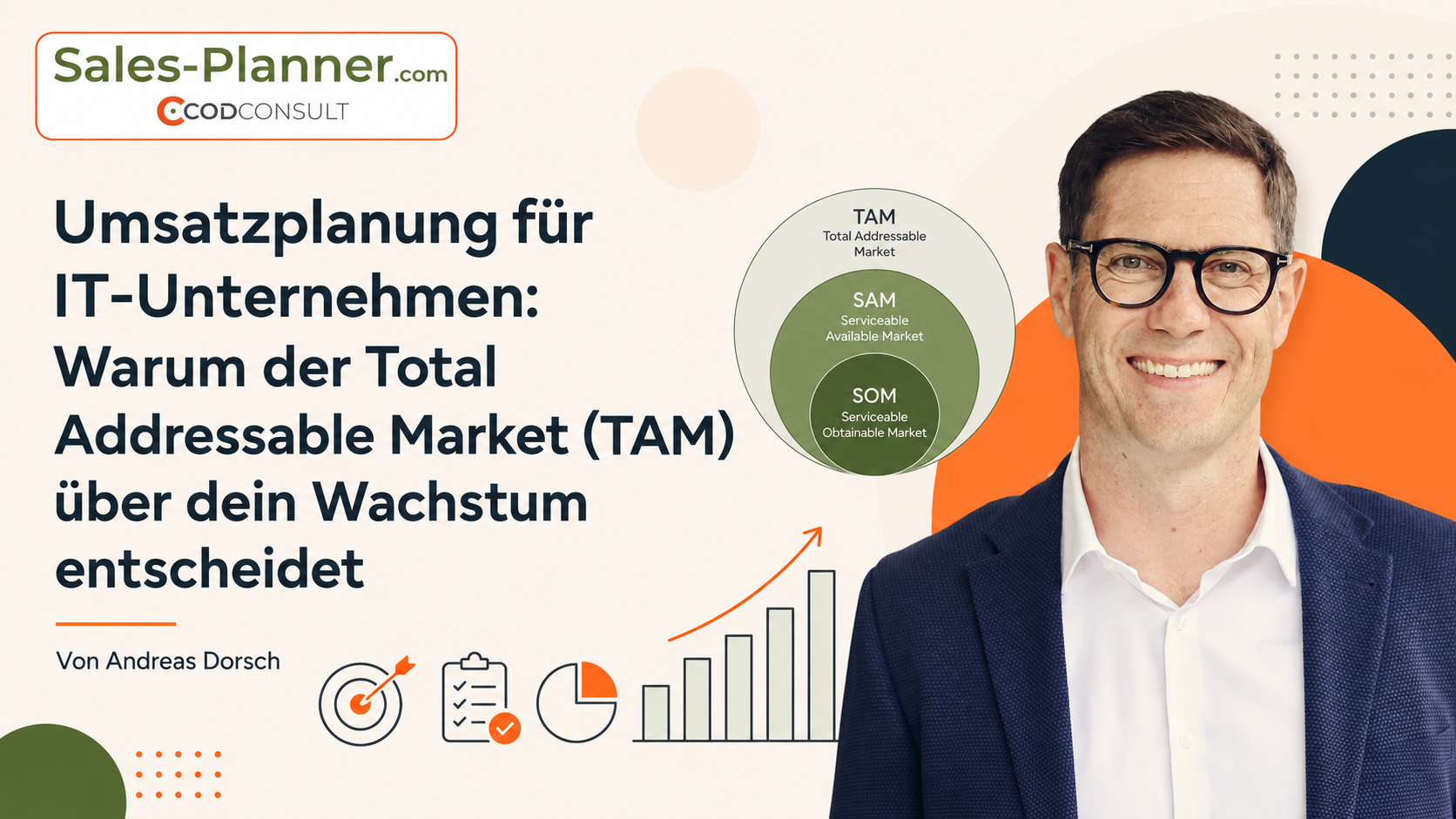
The Total Addressable Market (TAM) describes the entire market a company could theoretically address. Together with SAM (Serviceable Addressable Market) and SOM (Serviceable Obtainable Market), it forms the foundation of any sound revenue plan.
For IT companies, TAM is much more than a number in an investor pitch. It is the strategic tool that forces leaders to answer the right questions:
- Who is my target market really? Not in broad strokes — but by industry, company size, maturity, and willingness to buy.
- How am I positioned in that market? And how are my competitors?
- Does this target market support my growth ambitions for the next 3–5 years?
- What measures do I need in sales, marketing, and delivery?
- Where is the actual bottleneck in opening up the market — and how do I remove it?
Cutting the TAM badly costs revenue
The most common mistake in revenue planning for IT companies: the TAM is defined too broadly. "All companies that use IT" is not a target market — it's a universe with no basis for action.
Cutting the TAM too broadly leads to wrong decisions in product development, wrong sales channels and marketing channels, the wrong skill set in the team, and inefficient use of budget and funding — especially critical for software vendors dependent on investor capital.
Long-term planning as a competitive advantage
Precisely because customer decisions are slowing down today and market dynamics shift quickly, long-term revenue planning becomes a genuine differentiator for IT companies. Companies that know where they want to go and which market they need to open up act. Everyone else reacts — often too late.
Free Webinar: Cutting TAM Correctly and Growing Revenue
- Date: June 18, 2026
- Time: 1:00 PM CET
- Format: Microsoft Teams
What you'll take away: defining your target market precisely, structuring revenue planning, removing bottlenecks, making growth predictable.
→ Register for free: tinyurl.com/Zielmarkt
Related reading
Once you've cut the TAM cleanly, the next question is right around the corner: how many reps do I need to actually open up that market? Read the deep dive on sales capacity planning and the guide to Revenue Operations as a growth driver. Concrete use cases show how different roles operationalize the plan.
Frequently Asked Questions on Revenue Planning for IT Companies
What is the difference between TAM, SAM, and SOM?
TAM (Total Addressable Market) is the total theoretically reachable market. SAM (Serviceable Addressable Market) is the portion of it a company can realistically serve with its offering. SOM (Serviceable Obtainable Market) is the share that can actually be won in the short to medium term. All three levels are relevant for sound revenue planning in IT.
How do I create a revenue plan for my IT company?
A solid revenue plan starts with a clear definition of the target market (TAM), followed by positioning analysis, market-potential estimation, and the derivation of concrete sales and marketing measures. Interim managers or specialized consultants can accelerate this process considerably.
Why is the target market so decisive for IT service providers and MSPs?
Because every other strategic decision — product development, team build-out, budgeting, partnerships — depends on it. A wrongly cut target market leads to inefficient use of resources and slower growth.
Want to structure your target market and revenue plan with an expert? Talk to Andreas or try the planning tool free for two weeks.
Go from reading to doing — in 2 weeks.
Try the planning tool for free, or talk to Andreas about your specific situation.
The playbooks Andreas only shares with paying clients — straight to your inbox.
Four letters a year. Each one packed with frameworks, numbers and lessons from live enterprise engagements. No marketing fluff, no generic sales coaching.
- 1 deep-dive framework
Ready to use — from pipeline reviews to quota logic.
- 1 live lesson
What worked (or didn't) this week on a 7-figure engagement.
- 1 RevOps tool
One we actually pay for — with an honest verdict.
- No spam, ever
- 1-click unsubscribe
- GDPR-compliant · EU-hosted
Andreas writes about B2B sales, RevOps, and scaling enterprise sales teams drawing from 20 years of experience.