
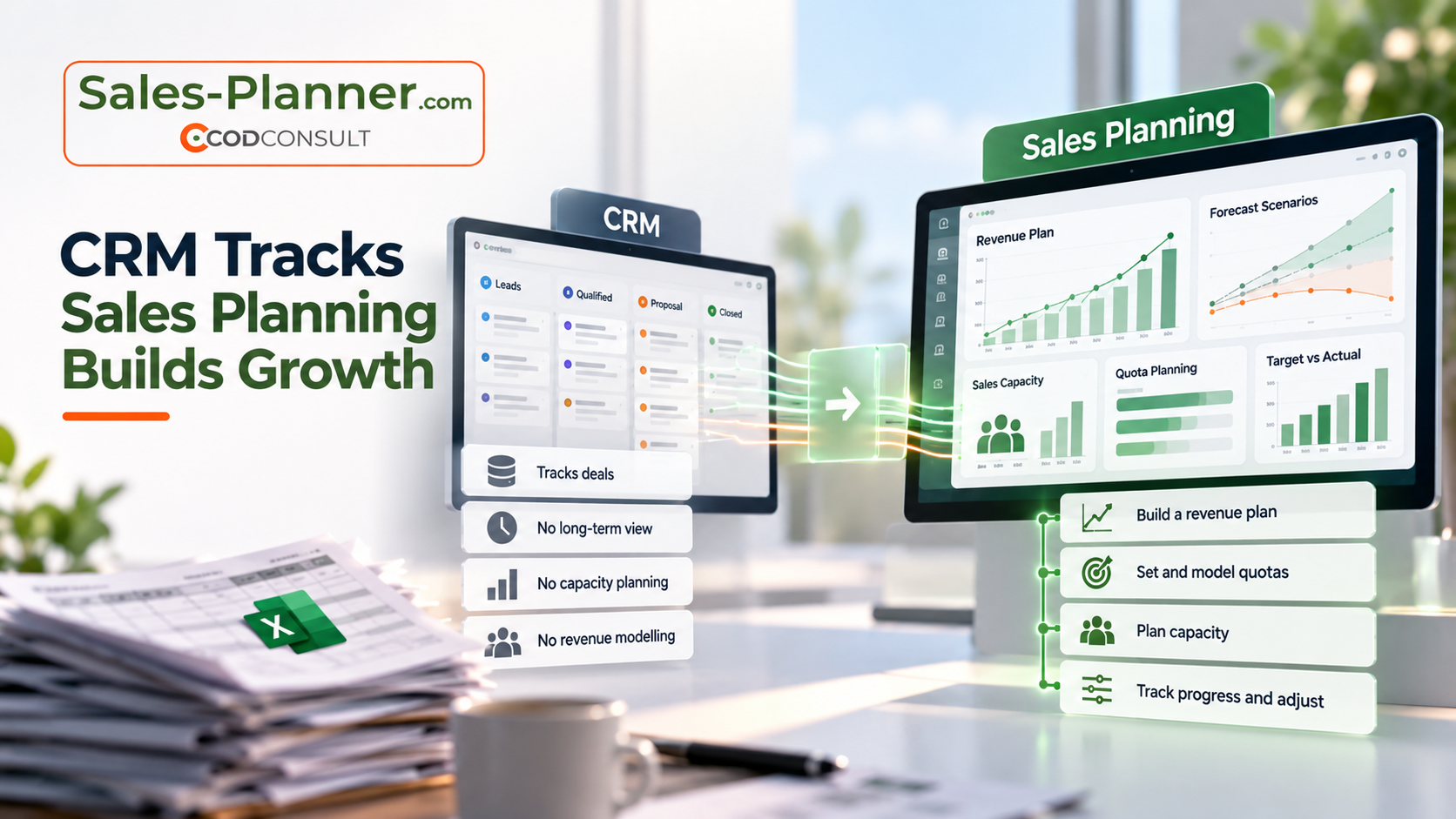
Ask your CRM a simple question: “If we hire two reps in March, do we still hit the number?”
It can't answer. It was never built to.
That's not a flaw in your CRM. It's a category error in how most teams use it. A CRM records what's happening. A plan decides what should happen. Those are two different jobs, and the second one is where your number comes from.
What your CRM is actually for
Contacts, deals, stages, activity, next steps. A CRM is a system of record, and a good one. It tells you what's in the pipeline right now and what each rep did yesterday. Keep it. You need it.
But a record of the present isn't a plan for the future. Ask it the questions that decide your quarter, and it goes quiet.
The three questions a CRM can't answer
What should each rep carry, and does the sum hit the board number? That's quota allocation: top-down target reconciled with bottom-up capacity. Your CRM has no concept of it.
What happens to the forecast if a driver changes? Add two reps, drop win rate two points, extend the ramp a month: a CRM can't model the scenario. It only shows the deals that already exist.
Are we on track against the plan? Your CRM shows €2,400,000 of open pipeline and calls it healthy. It won't tell you that €2,400,000 at a 25% win rate is €600,000 of expected revenue, against a €1,000,000 quarter: a €400,000 gap. That's planning math, and the CRM doesn't do math about the future.
Why bolting planning onto the CRM fails
So teams try to force it: custom fields, a reporting module, a spreadsheet export every Monday. It works until the CRM admin leaves, a field changes, and the whole fragile structure quietly breaks. CRMs aren't planning tools with some fields missing. They're the wrong shape for the job. A planning layer on top of your CRM is the right one.
What the planning layer adds
It sits above the CRM and pulls the live pipeline in. Then it does what the CRM can't: allocate quota, model capacity and ramp, run best-case and worst-case scenarios, and keep a rolling forecast against plan. You don't rip anything out. You add the layer that turns deals into a plan. That's exactly what the Sales Planner tool is built to do.
FAQ
Does sales planning replace my CRM?
No. It sits on top and syncs with it. The CRM runs deals; the planning layer runs quotas, capacity, and the forecast.
Can't Salesforce or HubSpot do planning?
Only loosely. They're built to track deals, not to allocate quota top-down and bottom-up or model scenarios against a target.
What does a planning layer add that a CRM doesn't?
Quota allocation, capacity and ramp modelling, scenario planning, and a rolling forecast measured against plan, not just against last week.
Which CRMs does it work with?
The common ones: Salesforce, HubSpot, Pipedrive, and others. The plan reads your real pipeline instead of a stale export.
Go from reading to doing — in 2 weeks.
Try the planning tool for free, or talk to Andreas about your specific situation.
The playbooks Andreas only shares with paying clients — straight to your inbox.
Four letters a year. Each one packed with frameworks, numbers and lessons from live enterprise engagements. No marketing fluff, no generic sales coaching.
- 1 deep-dive framework
Ready to use — from pipeline reviews to quota logic.
- 1 live lesson
What worked (or didn't) this week on a 7-figure engagement.
- 1 RevOps tool
One we actually pay for — with an honest verdict.
- No spam, ever
- 1-click unsubscribe
- GDPR-compliant · EU-hosted
Andreas writes about B2B sales, RevOps, and scaling enterprise sales teams drawing from 20 years of experience.